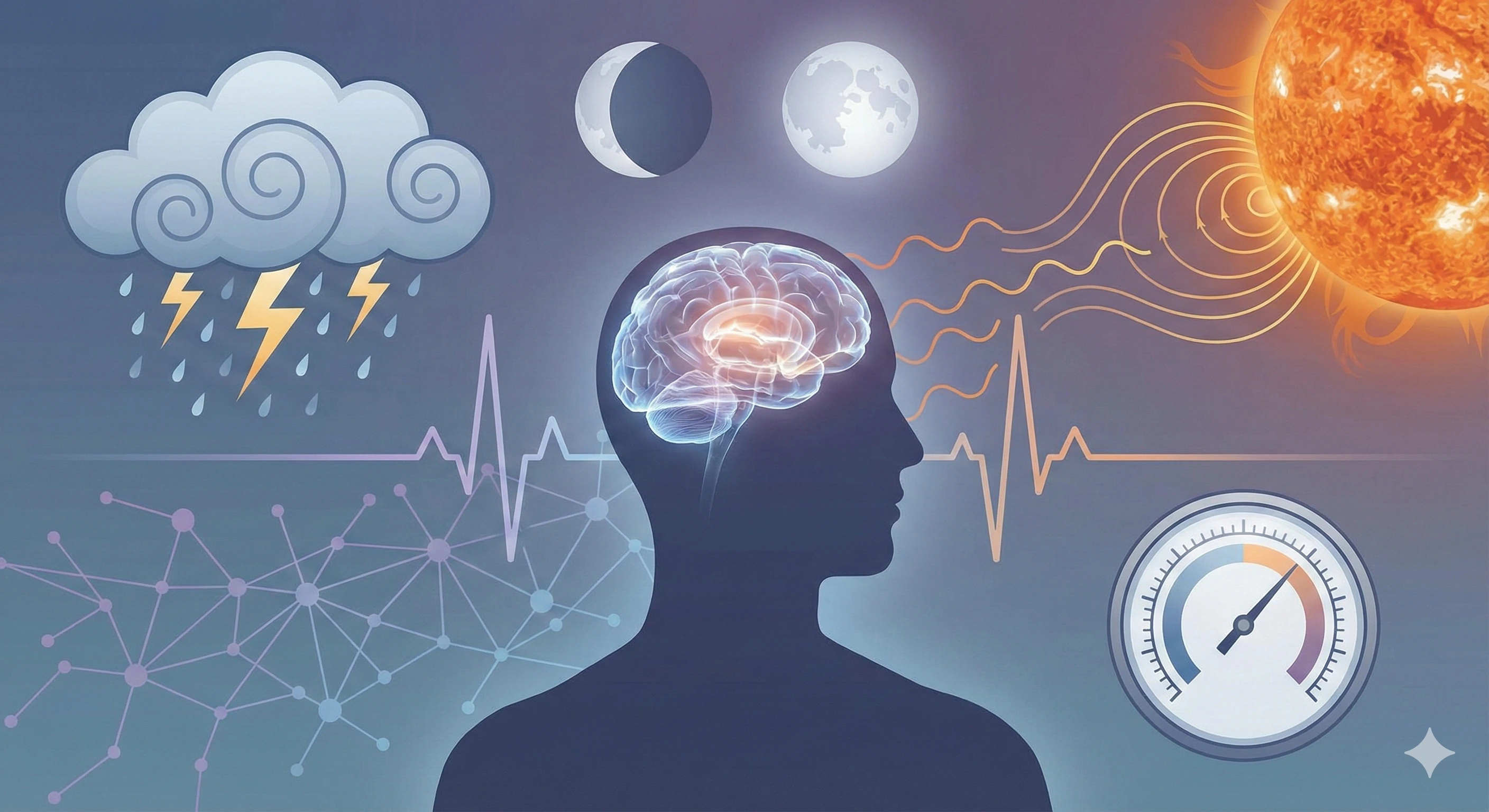
For many decades, complaints about "joint pain before rain" or "heaviness in the head during magnetic storms" were dismissed as hypochondria or autosuggestion. However, the development of clinical biometeorology has allowed us to look at the problem differently. The human body is an open biological system that constantly adjusts to external physical fields.
When the mechanisms of this adjustment (adaptation) fail, a condition arises that we call meteosensitivity or meteopathy. In this article, we will examine what exactly happens to our nervous system under the influence of atmospheric pressure, solar activity, and even lunar cycles, based on evidence-based medicine.
Physical Triggers and Their Effect on Neurological Status
1. Barometric Pressure and "Storm Headaches"
Atmospheric pressure is the force with which an air column presses upon us. A sharp drop in pressure (cyclone) leads to the expansion of cerebral vessels and changes in cerebrospinal fluid pressure.
Mechanism: Baroreceptors are located in the walls of the carotid arteries and in the cranial sinuses. When external pressure drops, they send a signal to the hypothalamus. In people with migraines, this triggers a cascade of reactions: serotonin release, constriction, and then abrupt dilation of brain blood vessels.
Research: Japanese scientists, through long-term monitoring of pain diaries from migraine patients, established a clear correlation: a pressure drop of just 6-10 hectopascals (approximately 5-7 mmHg) significantly increases the frequency of attacks.
2. Geomagnetic Activity and Solar Flares
Solar flares emit streams of charged particles that cause disturbances to Earth's magnetic field (storms). Our nervous system is electrochemical by nature, so it is sensitive to these changes.
- The Role of Melatonin: Research shows that geomagnetic activity suppresses melatonin synthesis in the pineal gland. Melatonin is not only responsible for sleep but is also a powerful antioxidant and regulator of vascular tone. Melatonin deficiency during storms leads to disruption of circadian rhythms and increased blood viscosity.
- Magnetite in the Brain: Microscopic magnetite crystals have been found in human brain tissue (especially in the cortex and cerebellum). They may act as internal compasses, transmitting signals about magnetic fluctuations directly to neurons.
3. Full Moon and Sleep Quality
Despite its mystical aura, the Moon's influence on sleep has a biological explanation. In a study published in Current Biology, it was proven that during the full moon, brain activity associated with deep sleep (delta waves) decreases by 30%. Patients take an average of 5 minutes longer to fall asleep and sleep 20 minutes less. This is attributed to vestigial "biological clock" mechanisms that respond to the lunar cycle regardless of lighting.
Who Suffers from Weather? (Statistics and Demographics)
Large-scale population surveys in Europe and Asia allow us to create an accurate profile of a meteosensitive person:
| Parameter | Statistical Data |
|---|---|
| Gender | Women (65-72%) suffer more often than men (35%). This is due to estrogen levels: estrogens modulate the sensitivity of pain receptors and vascular reactivity. |
| Age | The main group is 45-65 years old. However, "weather migraine" is becoming younger: up to 25% of those surveyed aged 18-30 report complaints, especially in megacities. |
| Seasonality | Peak complaints occur in November (minimal sunlight, pressure fluctuations) and March (depletion of vitamin resources and adaptation systems). |
| Location | City dwellers are 3 times more sensitive than rural residents due to "sick building syndrome" and lack of natural vascular conditioning. |
Correction Methods: How to Help Your Nervous System?
Meteosensitivity is not a verdict, but a signal of decreased adaptive capacity. Our task as physicians is to raise the body's sensitivity threshold.
1. Non-Drug Methods (Foundation)
- Autonomic Training: Regular contrast showers and sauna (if no contraindications) "teach" blood vessels to quickly constrict and dilate.
- Light Therapy: During autumn-winter periods, using lamps with 10,000 lux brightness helps maintain serotonin and melatonin levels.
- Diet on "Risk Days": Limiting salt (preventing swelling of the vascular wall) and foods rich in tyramine (aged cheese, wine, chocolate) that can trigger migraines.
2. Support with Nutraceuticals and Medications
- Magnesium (citrate or glycinate form): Magnesium blocks NMDA receptors, reducing overall nervous system excitability and preventing spasms.
- Antioxidants (Vitamins E, C, Alpha-lipoic acid): Help brain cells cope with oxidative stress during magnetic storms.
- Melatonin: Taking small doses of melatonin before a predicted magnetic storm helps "trick" the body and maintain sleep rhythm.
Scientific Sources and Literature
For those who want to study the evidence base more deeply, here is a list of key scientific works:
- Atmospheric Pressure and Migraine: The effects of barometric pressure on headache and migraine
- Geomagnetic Storms and Health: Geomagnetic disturbances and cardiovascular mortality
- Moon's Influence on Sleep (Basel Study): Evidence that the Lunar Cycle Influences Human Sleep
- Weather and Chronic Pain Connection: How weather affects chronic pain
- Medical Climatology and Nervous System: Biometeorology and its effect on human health
- Solar Flares and Psychological State: Solar activity and its impact on human mental health
This article is for informational purposes and is not medical advice. If you have symptoms, please consult with us.