Patients suffering from anxiety disorders, chronic insomnia, and autonomic dysfunction often fall into the same cognitive trap. They are convinced that normalizing their condition requires effort: trying harder to sleep, carefully controlling their heartbeat, or actively suppressing tremors or nervousness.
However, from a neurophysiological perspective, this very mechanism—the attempt to consciously control autonomic processes—is the primary fuel for neurosis. Viktor Frankl, a professor of neurology and psychiatry, described this phenomenon and proposed a counterintuitive but effective solution known as paradoxical intention.
The Physiology of "Anticipatory Anxiety"
Why does the desire to "calm down" lead to the opposite effect? The answer lies in the functioning of the Autonomic Nervous System (ANS).
The ANS is divided into two branches:
- Sympathetic (responsible for mobilization, stress, activity, fear).
- Parasympathetic (responsible for relaxation, sleep, recovery).
Sleep, sexual arousal, normal breathing rhythms, and calmness are functions of the parasympathetic system. They operate automatically and only when we do not interfere.
When a person tells themselves, "I must fall asleep immediately, or I’ll be exhausted tomorrow," the brain perceives this as a combat mission. The cerebral cortex activates and sends an alarm signal to the amygdala (the fear center). In response, adrenaline and cortisol are released, and blood pressure rises. The sympathetic system is engaged.
This creates a vicious cycle that Frankl called anticipatory anxiety:
- The patient fears the symptom (insomnia or a panic attack).
- They attempt to suppress it through willpower (tension).
- This tension blocks the parasympathetic system.
- The symptom intensifies.
The Method of Paradoxical Intention: The Neurobiological Mechanism
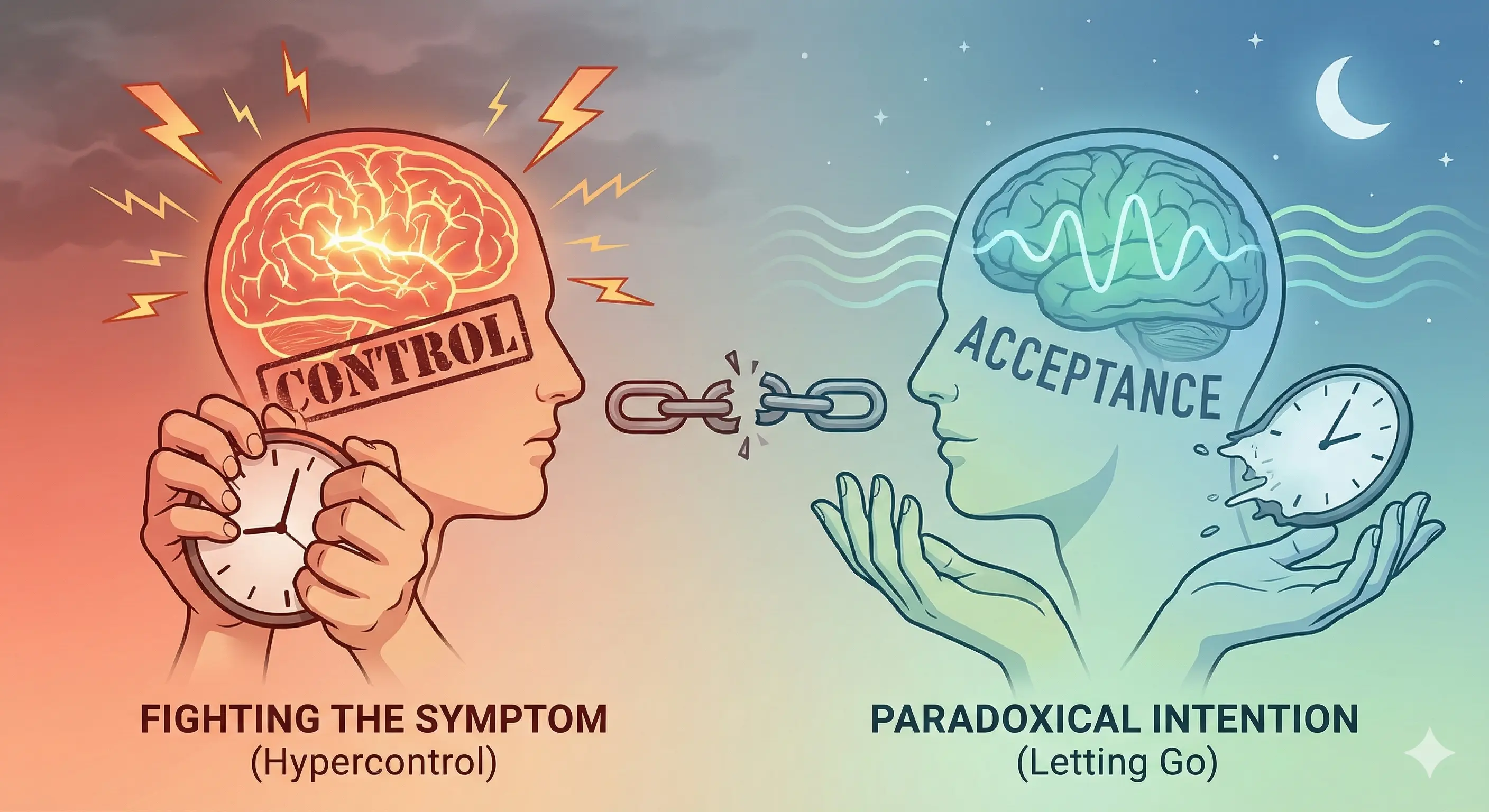
Viktor Frankl proposed a radical way to break this reflex arc. Instead of fighting the symptom, the patient is instructed to desire its occurrence and even exaggerate it.
The essence of the method lies not in magic or autosuggestion, but in switching the dominant focus in the brain.
Example with Insomnia
Instead of the imperative "I must sleep," the patient receives the instruction: "Try to stay awake as long as possible. Lie with your eyes open and resist sleep."
What happens: The fear of "not sleeping" disappears (since the goal has changed to the opposite). Anxiety levels drop, and the production of stress hormones ceases. In the absence of resistance, the brain's natural inhibitory processes take over, and the person falls asleep.
Example with Tremors and Panic Attacks
A patient who fears shaking in public or fainting is given an internal instruction: "I will show everyone how hard I can shake. I will hold a shivering competition."
What happens: The desire to induce the symptom shifts the patient from the passive position of a victim (fearing an uncontrollable event) to an active position. Since the sympathetic system cannot operate at peak capacity indefinitely without the fuel of fear, the autonomic storm subsides.
Clinical Significance of Giving Up the Fight
In modern Cognitive Behavioral Therapy (CBT) and neurology, the method of paradoxical intention is recognized as an effective short-term therapy tool. It demonstrates that the pathology lies not in the symptom itself, but in the fixation on it.
Attempting to "relax by force" is an oxymoron for the nervous system. Healthy autonomic processes occur in the background. Health returns the moment the patient stops monitoring their condition and relinquishes hypercontrol.
Paradoxical intention teaches the brain a simple lesson: the symptom is safe. And if there is no danger, there is no need for anxiety.
Sources
This article used data from the following official sources:
- Original methodology and description of the mechanism: Frankl, V. E. (1975). Paradoxical intention: A logotherapeutic technique.
- Efficacy in treating insomnia (Clinical Guidelines): American Academy of Sleep Medicine.
- Meta-analysis of efficacy in anxiety disorders: Ascher, L. M., & Turner, R. M. (1979).
- Modern review of cognitive mechanisms: Seli, P., et al. (2016). On the Clock: Evidence for the Rapid and Strategic Modulation of Mind Wandering.
This article is for informational purposes only and does not constitute medical advice. If you have symptoms, please consult a specialist.