Cognitive biases are not just random errors of perception; they are fundamental features of our neurobiological system. In modern psychology and neuroscience, they are viewed as a result of the brain's evolutionary adaptation to the need to rapidly process vast amounts of data under conditions of uncertainty.
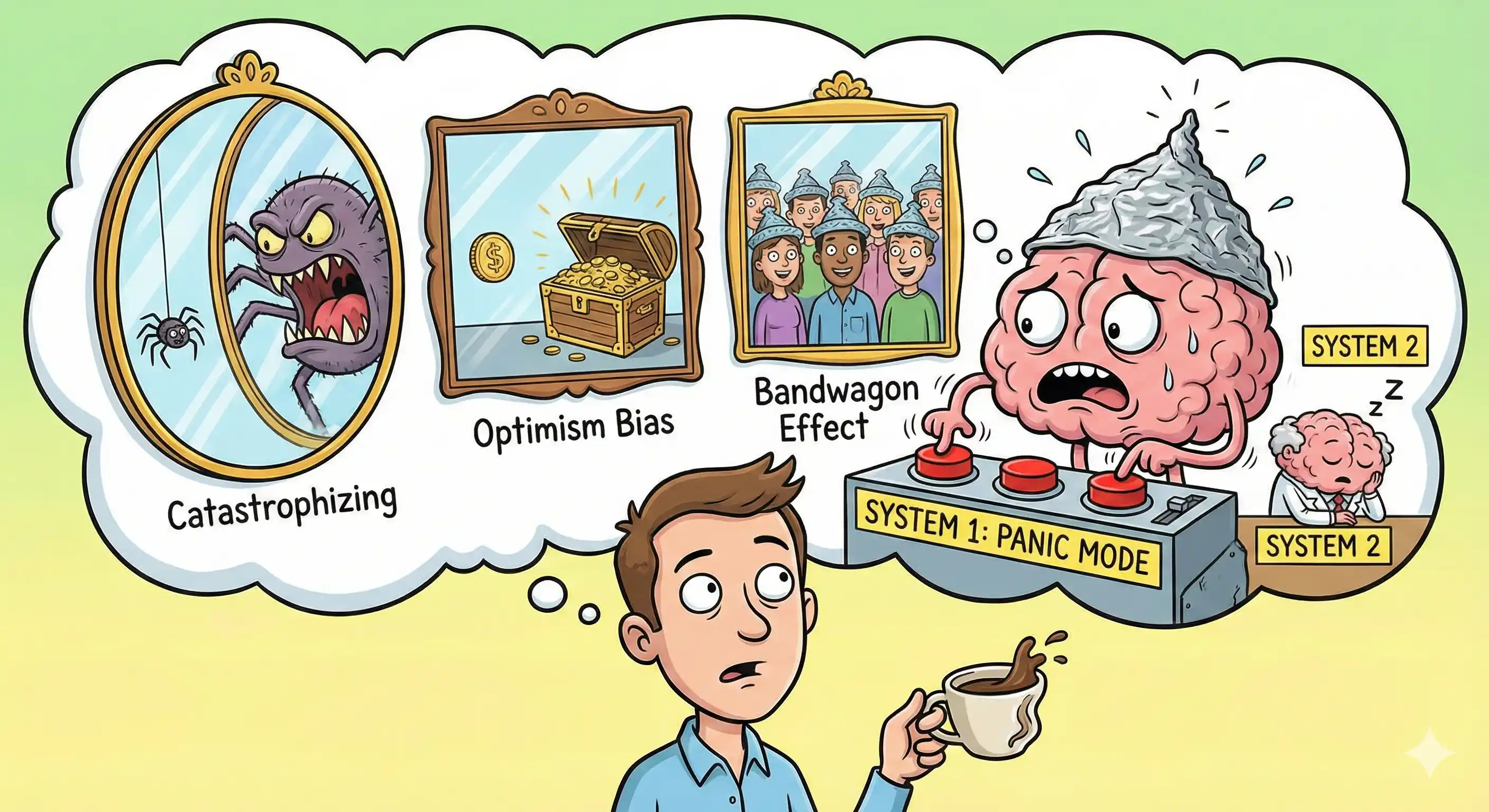
Nobel laureate Daniel Kahneman proposed splitting our thinking into two systems: System 1 (fast, intuitive, and emotional) and System 2 (slow, logical, and effortful). Most biases arise from System 1, which uses "heuristics" — mental shortcuts — to save energy.
Part 1: A Catalog of Mental Traps
1. Information Availability and the Magic of Repetition
The brain tends to evaluate the probability or importance of an event based on how easily examples of that event come to memory.
- Availability Cascade: A repeatedly repeated idea starts to seem true, as our mind subconsciously trusts what is familiar.
- Bandwagon Effect: The more people share a view, the more substantiated it seems to our brain.
- Risk Perception Distortion: We often fear plane crashes more than car accidents because the former are covered much more intensely in the media.
2. The Neurobiology of Fear: Catastrophizing
Our brain evolved for survival, so it pays much more attention to negative signals.
- Catastrophizing: The tendency to expect the worst possible scenario, even with minimal indications. Research shows that catastrophizing causes temporary work disability more often than depression.
- The Role of the Amygdala: This brain structure reacts instantly to potential threats (e.g., when a loved one doesn't answer the phone), triggering a cascade of stress reactions before the logical prefrontal cortex can intervene.
3. Social Biases: From Dunning-Kruger to "False Consensus"
- Dunning-Kruger Effect: Individuals with a low level of competence fail to realize their mistakes precisely because they lack the knowledge necessary to evaluate them.
- False Consensus Effect: We tend to overestimate the degree to which others share our views and feelings. If someone disagrees, System 1 often labels them as "weird" or "deficient."
Part 2: Combat Strategies – How to "Rewire" Your Thinking
While it is impossible to completely get rid of biases, science offers tools to reduce their influence. This process is called cognitive debiasing.
1. Metacognition: Observing the Observer
Metacognition is the ability to think about the way we think.
How to apply: In moments of intense emotions or quick conclusions, pause and ask yourself: "Why did I decide this? What facts do I have, and what did I just assume?". This forcibly activates System 2.
2. The "Devil's Advocate" Method
Actively searching for reasons why your belief might be wrong significantly reduces confirmation bias.
How to apply: Formulate a position opposite to your own and try to find three strong arguments in its favor. This "softens" the rigidity of the initial conclusion.
3. The "Pre-mortem" Technique
A method proposed by psychologist Gary Klein to combat excessive optimism or catastrophizing.
How to apply: Imagine that your project or decision has failed spectacularly after a year. Now describe the causes that led to this collapse. This allows the mind to see hidden risks that System 1 ignored.
4. Distancing: The "Other Person" Rule
When we are emotionally involved, our perception narrows.
How to apply: If you are in a state of catastrophizing, imagine that a friend is in your position. What advice would you give them? Research shows we are much more objective about others' problems than our own.
Part 3: Practical Application Examples
| Bias | Real Situation | Combat Strategy |
|---|---|---|
| Gambler's Fallacy | An investor sees stocks falling for 5 days and assumes they "must" go up tomorrow. | Metacognition: Remind yourself that the probability of an event tomorrow does not depend on what happened yesterday. |
| Catastrophizing | An error in a report leads to the thought: "I will definitely get fired; I'll end up homeless." | Distancing: Search for facts that disprove the scenario (e.g., has anyone ever been fired for a single typo?). |
| Dunning-Kruger | A beginner believes they have learned a foreign language perfectly after one week of lessons. | Objective Check: Take an independent test or seek feedback from an expert. |
Sources and Bibliography
- Original Article (Source Material) — Reminder
- Editorial: Highlights in psychology: cognitive bias — PMC
- The Neuroscience of Decision-Making — Walsh Medical Media
- How Cognitive Biases Influence the Way You Think and Act — Verywell Mind
- 3 Reasons Why Your Brain Loves Negative Thinking — Psychology Today
- Thinking, Fast and Slow (Daniel Kahneman) — Wikipedia
- Decision Hygiene: How to Avoid Psychological Traps — Harvard Business Review
This article is for informational purposes only and is not a medical or psychological diagnosis. If needed, I am happy to help you.