In 1976, historian Carlo Cipolla formulated his famous "Basic Laws of Human Stupidity." He defined a stupid person not as someone with low intelligence, but as someone whose actions cause harm to others and, paradoxically, to themselves.
To a neurologist, this definition sounds surprisingly familiar. In medicine, we do not call this "stupidity," but rather executive dysfunction. This is a condition where, despite high intelligence and intact memory, a person is unable to regulate their behavior for long-term benefit.
Let's analyze Cipolla's matrix through the prism of neurophysiology.
The Second Law: Intelligence Does Not Protect Against Stupidity
Cipolla asserted: "The probability that a certain person be stupid is independent of any other characteristic of that person." From the perspective of brain structure, this is an absolute truth.
Intelligence (IQ, logic, calculation) is handled by specific neural networks (often involving the parietal lobe), while rational behavior and impulse control are the domain of the Prefrontal Cortex (PFC). You can be a brilliant mathematician, but if the connections between your prefrontal cortex and the amygdala (the center of fear and aggression) are disrupted, you will commit destructive, irrational acts. Intelligence is the "engine power," while rationality is the "steering." A powerful engine without a steering wheel (the "Stupid" scenario) is more dangerous than a weak engine.
The Neurochemistry of the 4 Behavioral Types
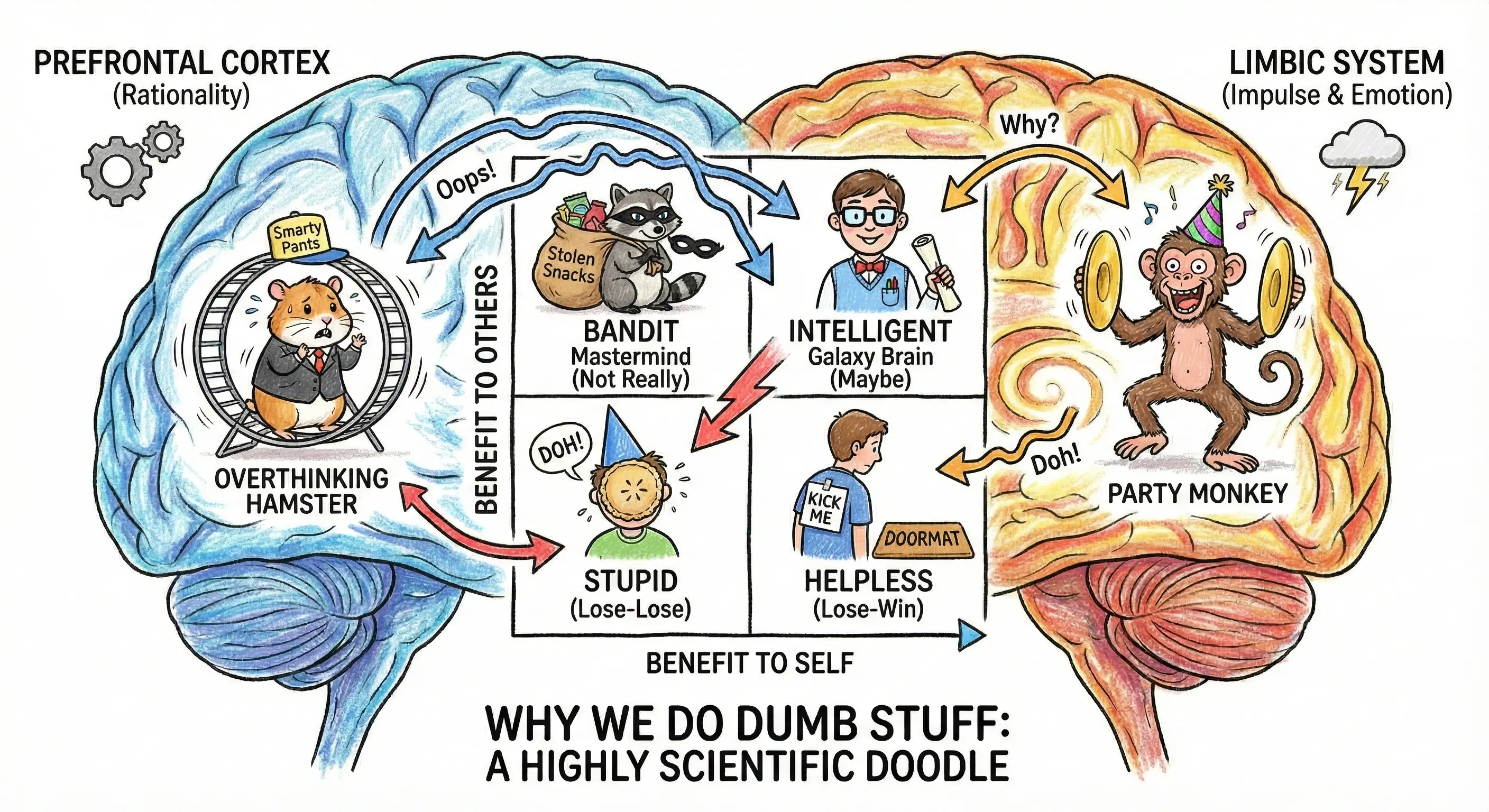
Cipolla divided people into 4 categories depending on whether they create benefit or harm for themselves and others. Let's look at this as a balance of neurotransmitters.
1. The Helpless (Prostaki) — [Harm to Self / Benefit to Others]
Neuroprofile: Excess empathy, noradrenaline deficit. These are people with suppressed aggression and high mirror neuron activity. They do not know how to protect their boundaries. Their brain rewards them (with an oxytocin release) for social approval, even if it costs them their health. In neurology, this is a direct path to asthenia and psychosomatic burnout.
2. The Bandits — [Benefit to Self / Harm to Others]
Neuroprofile: Dopamine addiction, reduced empathy. This is classic "predator" behavior. The limbic system demands immediate reward (resources, status, pleasure) at any cost. The prefrontal cortex is functioning, but it serves primitive impulses, devising cunning plans to satisfy them. This is not stupidity; it is parasitism.
3. The Intelligent — [Benefit to Self / Benefit to Others]
Neuroprofile: The Integrated Brain. A state where the "emotional brain" and the "rational brain" work in sync. The person is capable of delaying immediate gratification for a greater goal (PFC function) and possesses empathy, understanding that cooperation (Win-Win) is energetically more efficient than conflict. This is the gold standard of mental health.
4. The Stupid — [Harm to Self / Harm to Others]
Neuroprofile: Dysregulation and the Cortisol Loop. The most dangerous type according to Cipolla. In neurology, this corresponds to a state of chronic stress or affect. When a person is under the rule of "fight or flight," their frontal lobes shut down. They yell at their boss (losing their job), start scandals with loved ones (destroying their family), or abuse alcohol (destroying neurons).
The Main Paradox: The "Stupid" person acts this way not because they want to cause evil, but because their brain has lost the ability to predict consequences. This is a functional lobotomy—a temporary shutdown of control centers.
Why the Stupid Person is the Most Dangerous (5th Law)
Cipolla wrote: "A stupid person is more dangerous than a bandit." A Bandit is predictable because they are rational in their selfishness. A Stupid person is chaos.
From a medical standpoint, "Stupid" behavior (Lose-Lose) is entropy. It is a violation of homeostasis. For example, addictions (alcoholism, gambling) fit perfectly into this quadrant: the person harms those around them (family) and inflicts colossal harm on themselves. The "Stupid" brain operates on faulty neural pathways: it mistakes a stimulus that destroys the organism for a survival stimulus.
Therapeutic Summary
The Third Law of Stupidity states that irrational actions lead to losses. In neurology, we know: neuroplasticity works both ways. If you regularly perform actions from the "Stupid" category (emotional breakdowns, sabotaging your health), the brain myelinates these pathways, making "stupidity" your automatic reaction.
The Patient's Goal: Move into the "Intelligent" quadrant. This is not a matter of education or reading books. It is a matter of training the inhibitory pathways of the cerebral cortex.
- Pause: Between stimulus and reaction.
- Reflection: "Will this action bring benefit to me and the system in the long term?"
- Lower Cortisol: Eliminate chronic inflammation and sleep deprivation, which stupefy the frontal lobes.
Do not let your limbic system dictate the laws of your life.
Sources
- Bechara, A., Damasio, H., & Damasio, A. R. (2000). Emotion, Decision Making and the Orbitofrontal Cortex. Cerebral Cortex.
- Cipolla, C. M. (2011). The Basic Laws of Human Stupidity. Il Mulino. Penguin Books Edition
- Sapolsky, R. M. (2017). Behave: The Biology of Humans at Our Best and Worst. Penguin Press.
- Kahneman, D. (2011). Thinking, Fast and Slow. Farrar, Straus and Giroux.
The article is for informational purposes only. If you notice signs of behavioral disorders, anxiety, or chronic stress in yourself or loved ones, schedule a consultation.